

One-Pot Cooking, The Japanese Way
Naoko Takei Moore shares her go-to salmon recipe—and her love for the donabe.

Thanks for being here! Every week in this newsletter, I share a conversation with a cookbook author (like Natalia Rudin, Molly Baz, Dorie Greenspan, Yasmin Khan, and Flora Shedden) and a recipe from their newest book. Today’s simple salmon and quinoa is a must-try. I also give away a cookbook to one reader in every send—details are below.
The weekly recipe is free, but paid subscribers get access to the full collated list of every single cookbook recommended on the show’s 84 episodes, and seasonal collections like this resource with 43 winter dinner ideas you didn’t have to think of, and this one, which has 99 more ideas. Throw a dart at it, and dinner is solved.
When you see Naoko Takei Moore’s shelves at home, which display just the 30 or so Japanese clay pots that she needs close at hand—you start to understand why people call her Mrs. Donabe.
She’s taught classes on cooking with these vessels, and wrote the first English-language book on the topic. She offers a wide range of different styles at her shop in Los Angeles: individual-sized pots and donabe for groups, donabe with double lids for better rice steaming, and donabe designed with grates for stove-top smoking.
“For Japanese people,” she tells me in today’s podcast conversation, “it’s like a national cookware; almost every household owns at least one donabe.”
When Naoko, who was born in Yokohama and grew up in Tokyo, arrived in Los Angeles in 2001, she says she found that some types of Japanese food were “quite popular, like sushi, tempura, other things. But not so much the Japanese real home cooking which I enjoyed eating as I grew up, and which, you know, is represented really by donabe cooking.”
While restaurant cooking often highlights precise technique, at home, Naoko says, things are simpler: “We always say, let the donabe do the work. Don’t worry about you having to do a lot of things.” For Naoko, “home cooking is really just naturally assembling food and letting the ingredients speak.”
Naoko’s new book, Simply Donabe, focuses on simple one-pot meals. In this week’s episode of The Dinner Plan podcast, I asked Naoko about the advantages of donabe cooking.
The key is the vessel’s “even heat distribution,” Naoko says, as well as the fact that “it’s very gentle.”
Naoko shares a recipe below which begins by steaming quinoa in the pot with dashi. “Right before turning off the heat, I place a piece of salmon” on top, she explains. The donabe stays hot even after you turn off the stove. “The carryover heat cooks the salmon really beautifully and perfectly,” she says, yielding tender fish that tastes purely of itself.
Scroll down for the recipe—but while you’re cooking, tune into the full episode to hear about Naoko’s go-to meals, her instructions for prepping a new donabe for cooking, and her advice on choosing and using different types of miso.
Win a copy of Simply Donabe

Want to add this cookbook to your collection? I want that for you, too! There are two different ways to enter this week’s giveaway:
🥇 This is easy: Sign up as a paid subscriber to this newsletter by end of day Sunday, February 22, 2026. That’s all you need to do. Becoming a paid subscriber also gives you full access to the 99+ Dinner Ideas list and this winter dinners edition.
🥈 Free subscribers can still enter the giveaway. Just send in a “what’s in my pantry/fridge/freezer right now” voice memo for us to play on The Dinner Plan podcast. An upcoming cookbook author guest will come up with a dinner idea just for you based on what you have around. Follow the instructions here by end of day Sunday, February 22, 2026.
Giveaway winner will be alerted by Substack DM and email. 18+, U.S. and Canada addresses only (sorry!). Giveaway not sponsored or administered by Substack. Ends Feb 22, 2026. This newsletter includes affiliate links; a small commission from your purchase helps to keep this newsletter (and the weekly podcast) going.
Naoko mentioned:
Naoko’s azuki bean porridge (video)
Classic-style donabe at Naoko’s shop, Toiro
Naoko’s recommended mirin
Warm tofu with sesame sauce (Naoko also recommends this tofu spinach hot pot)
Hot pot with chicken meatballs / another simple chicken meatball hot pot
Irina Janakievska’s The Balkan Kitchen, especially the oven-roasted sea bream recipe (Bookshop / Barnes & Noble / Amazon)
Marc Summers’s The Bubala Cookbook (Bookshop / Amazon)
Meredith Erickson and Martyn Nail’s Claridge’s: The Cookbook (used on Thriftbooks)
From the ad break:
Aunt Fannie’s cleaning supplies are available on Thrive Market and Amazon.
Made In Cookware: Head to madein.cc/dinnerplan to unlock your discount offer.
Society Insurance: Find your local agent at SocietyInsurance.com
Catch The Side Dish from America’s Test Kitchen on Netflix or wherever you listen to podcasts
Maggie mentioned:
Hilary Sterling’s dandelion-spinach pesto and raw turnip salad from Ammazza!
SPONSORED NOTE

If you’re cooking a lot, that means you’re cleaning a lot. If you’ve been looking for a way to ditch harsh chemicals, it’s time to switch to Aunt Fannie’s cleaners for every surface. Aunt Fannie's highly effective cleaners are dermatologist-tested and safe to use around food. Keep your kitchen shining with Aunt Fannie’s Granite & Stone Cleaner, Stainless Steel Cleaner, and Sink Refresher. I love their All-Purpose Cleaning Spray, too.
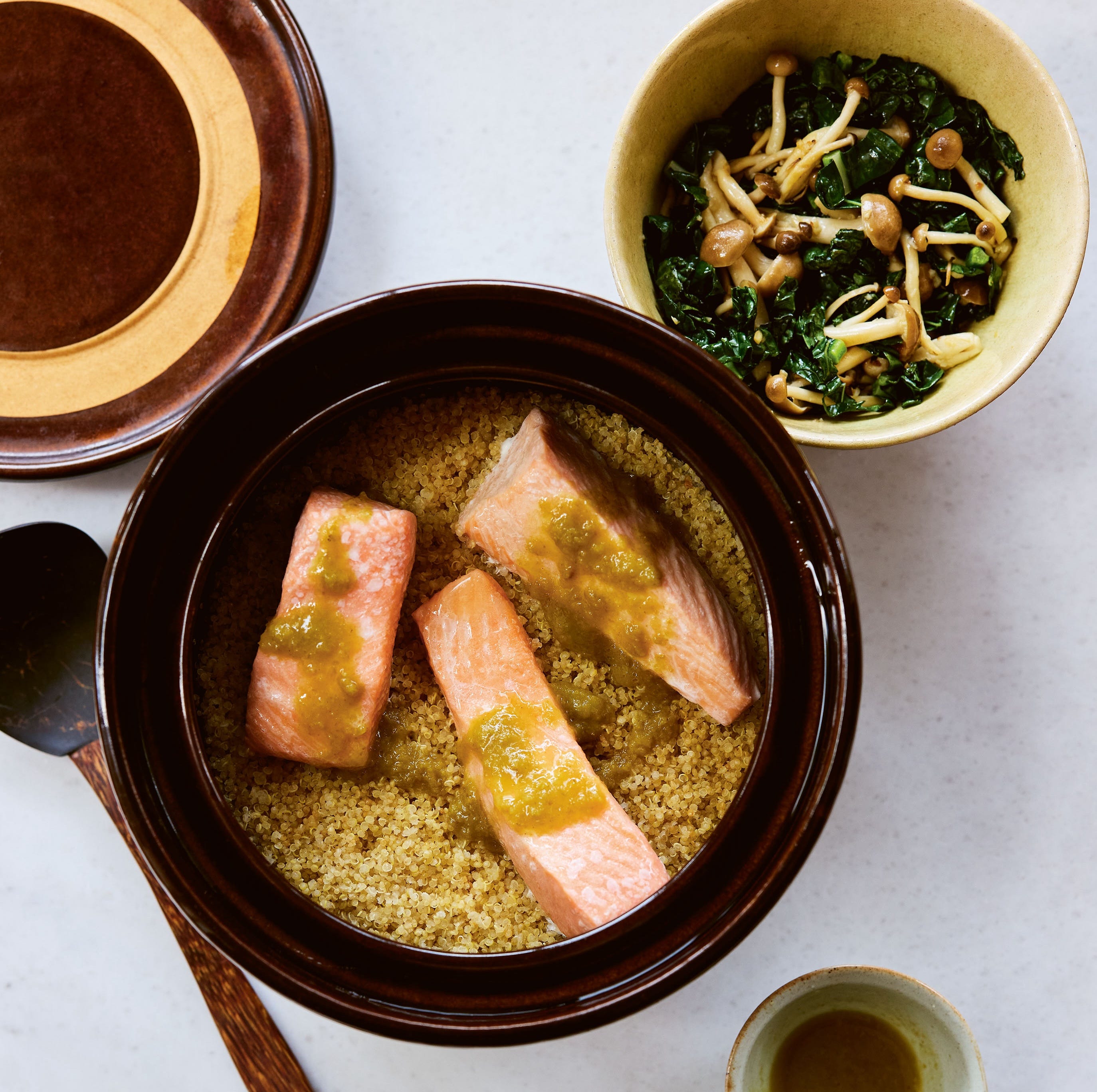
Takikomi Salmon Quinoa
Fluffy quinoa with salmon, kale and mushrooms
Excerpted with permission from Simply Donabe by Naoko Takei Moore (Quadrille, February 2026)
Cooking quinoa in a donabe makes it surprisingly fluffy and flavourful, with a delicate nutty texture. It’s so versatile that I often make a batch just to toss into salads. For this dish, I cook salmon and quinoa together in the donabe, then finish with sautéed kale and shimeji mushrooms. Everything is gently seasoned with a mix of yuzu-kosho (yuzu and green chilli pepper paste) and pure yuzu juice. It’s a great one-pot meal packed with delicious flavour and balanced nourishment.
Serves 3-4
Equipment: Classic-style donabe (or heavy duty pot) (1.2 litre/40 fl oz)
1 Tbsp. pure yuzu juice or lemon juice
1 tsp yuzu-kosho (yuzu and green chilli pepper paste), or more to taste
300 g (10½ oz) salmon fillet, cut into 2–3 pieces
200 g (1 cup) quinoa, rinsed
360 ml (1½ cups) Shojin Dashi (see below) or your choice of stock
2 Tbsp. sake
1 Tbsp. extra virgin olive oil
1 garlic clove, minced
100 g (3½ oz) shimeji mushrooms, trimmed
4–5 cavolo nero leaves (lacinato kale), cut into bite-size pieces
1 Tbsp. shoyu (or tamari for gluten free)
Sea salt and freshly ground black pepper, to taste
Whisk together the yuzu juice and yuzu-kosho in a small bowl. Adjust the amount of yuzu-kosho according to your liking.
Season the salmon with ½ teaspoon sea salt and refrigerate for 30 minutes, then pat dry with paper towel.
Combine the quinoa, dashi and sake in a donabe. Cover and set over a medium-high heat. Once it comes to the boil, reduce to a low simmer and cook for 10 minutes, or until all the moisture has been absorbed.
About 1 minute before turning off the heat, place the salmon fillets on top of the quinoa. Let it rest for 10 minutes and let the salmon cook in the residual heat.
Meanwhile, heat the olive oil in a sauté pan over a medium heat. Add the garlic and sauté until aromatic, then add the shimeji mushrooms and cook for 2–3 minutes. Add the cavolo nero and continue sautéing until just wilted. Pour the shoyu around the edge of the pan and let it sizzle for another minute. Turn off the heat.
Uncover the donabe and gently break up the salmon. Fluff together with the quinoa using a large spoon. Add the cavolo nero mixture and yuzu-kosho mixture. Fluff again to combine. Taste and adjust the seasoning with salt and black pepper.
Shojin Dashi / Kombu and Shiitake Mushroom Dashi
Excerpted with permission from Simply Donabe by Naoko Takei Moore (Quadrille, February 2026)
This is a standard dashi used in traditional shojin ryori (Buddhist temple cuisine). Dried shiitake gives the broth a rich, pronounced flavor, while kombu offers a cleaner, more soothing umami. You can adjust the ratio of the two depending on the dish. A deeper shiitake flavor works well for stews and braised dishes, while lighter soups benefit from more kombu and less shiitake for a more delicate finish.
Makes about 1 liter (about 4¼ cups)
Equipment: Classic-style donabe (or heavy duty pot) (1.8 liter/60 fl oz)
10 g (⅓ oz) dried shiitake mushrooms (about 4 small–medium pieces)
10–15 g (⅓–½ oz) kombu (dry kelp; about 2–3 pieces, 10 x 10 cm/4 x 4 in)
1.2 liters (5 cups) water (low mineral content preferred)
Quickly rinse the shiitake mushrooms under running water.
Soak the kombu and shiitake in the water in a bowl for 2–3 hours, or until the shiitake are fully rehydrated.
Transfer the kombu, shiitake and their soaking water to a donabe and set over a medium heat, uncovered. Just before the water starts boiling, about 25–30 minutes, remove the kombu and shiitake, squeezing the excess liquid out of the shiitake into the broth. The dashi is ready to use.
Every time I read about a donabe, I'm like "I need to get a donabe" and then I don't. I think it's time!!! It just sounds so magical! I gotta get the book too. Treat for meee.
I got a donabe and am excited to learn how to (finally) use it with this book