

How to Host the Ultimate Hot Pot Dinner This Winter
Let chef Natasha Pickowicz be your guide to gathering.

As I’m writing this ahead of the weekend, they say a foot of snow is on its way.
Nothing sounds better than getting together with friends with a steaming, burbling pot of broth at the center of the table. We’re lucky to have Natasha Pickowicz’s new book, Everyone Hot Pot, as our guide.
Hot pot, Natasha tells me, “is sort of a tonic, you know, when it’s bitterly cold. My mom grew up in Beijing,” she continues, where hot pot is a way of life, since “winters are a million times more intense than they are here in New York City. This is what you do to combat those feelings of coldness.”
There are hot pot traditions in warm climates, too, but for Natasha, “there is just something about the steam coming off the hot pot, and sort of fogging up the windows, creating that condensation on the glass.” She remembers “drawing little pictures in the steam that would fog up the windows” when she was a kid.
Her friends would beg to be invited over to join, and it was a meal where it felt like the “normal rules of decorum wouldn’t apply. So, you know, I could have as much of certain ingredients as I wanted, you know, without reprimand. I could make a bit of a mess, drop things on the table, you know, that was part of the magic.”
Where Western-style dinner parties could feel “kind of sanitized and neat and tight,” Natasha says, “Hotpot was something that you shared. You passed ingredients around. You cooked the food together in a communal bubbling pot of broth. To me as a kid, that turned it into this fun, interactive game.”
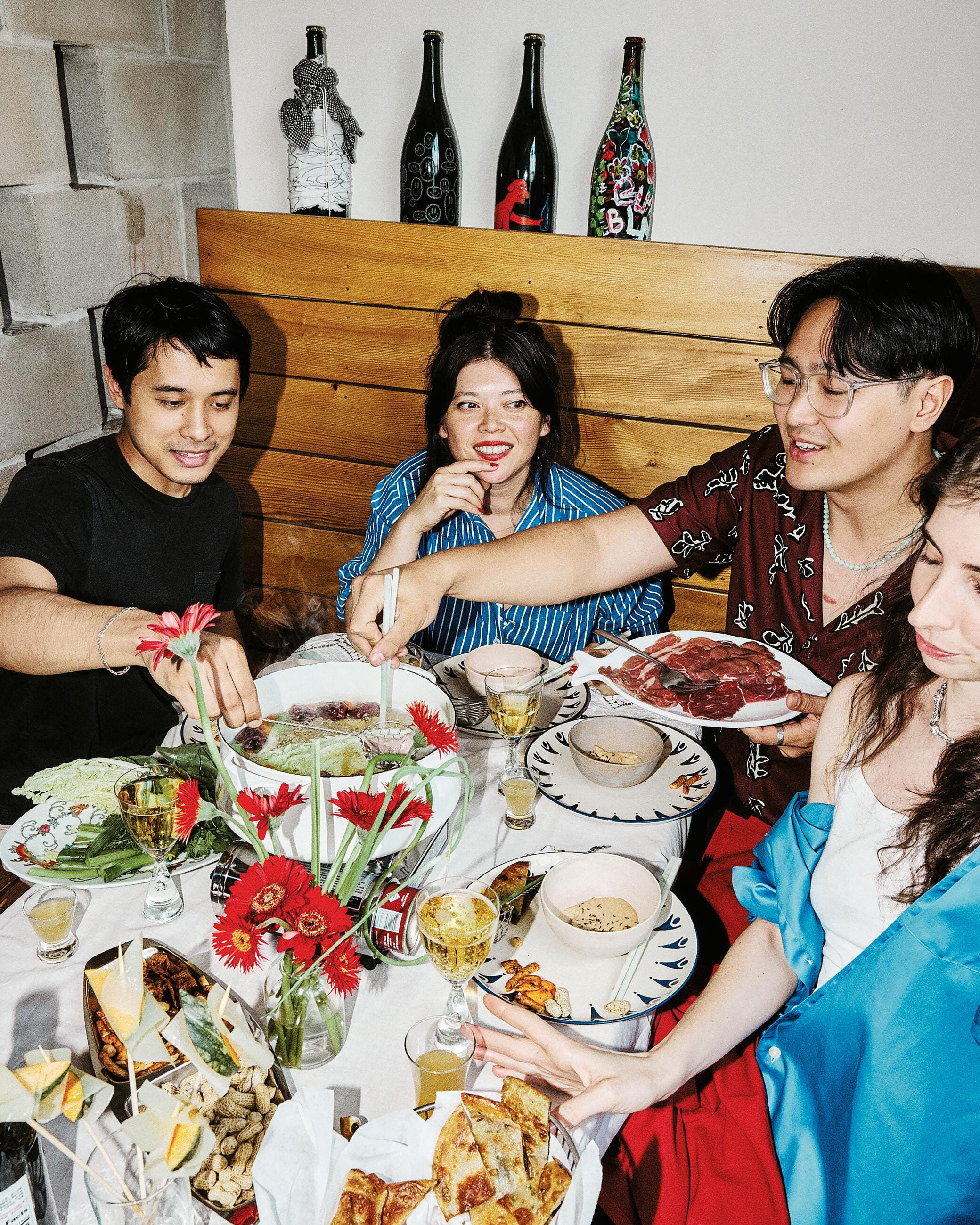
During our conversation, Natasha maps out a schedule: all the ingredients you can you grab in advance, what you can prep and stash in the freezer. (The latter includes the many-herbed scallion pancake recipe you’ll find if you scroll down the page.) She weighs in on the starter equipment you need and the balance of ingredients that’ll make for a well-rounded meal.
Your time commitment in the kitchen can be as lengthy or as limited as you want; most of the cooking happens at the table.
As Natasha explains: “If you like to make a charcuterie board, if you like to make a fruit plate, you know, if you like to make it look nice, hot pot is the meal for you!” You’ll put out frilly bunches of greens and mushrooms, and set out a plate of meat that you can even buy pre-sliced. Guests will arrive at the table and be wowed: “Your eyes register it as total over-the-top abundance. But in reality, what they’re seeing is mise en place. They’re seeing raw ingredients.”
If hosting usually stresses you out but you want to surround yourself with friends right now, hot pot is a great fix, Natasha explains.
Everyone Hot Pot provides a wide range of broth recipes, but even that is optional. “You can start with nothing,” Natasha says. “You can start with boiling water, like you’re putting on water for pasta.”
The easy prep and communal cooking right at the table set the tone. Natasha’s reminded of something her dad often says: “You could be seated next to a stranger at the hot pot table. And by the end of the night, you have a new best friend.” Going into the same pot together, cooking little morsels side by side, “it’s just incredibly fun,” she says.
Natasha encourages everyone to say a few words: “Maybe it’s just really short, like: happy to be here tonight. Some people, it gets surprisingly emotional.”
Even those who usually opt out of public speaking tend to get swept up in gratitude and enthusiasm. “Sometimes, you know, they get in the spirit of things. And those are the people who are like, actually, I do want to say something,” Natasha says. “And that’s really nice, too.”
Tune in for all of Natasha’s hot pot tips before you send that invite.
Win a Copy of Everyone Hot Pot

There are two different ways to enter to win a copy of Everyone Hot Pot this week.
🥇 Sign up as a paid subscriber to this newsletter by end of day Sunday, February 1, 2026. That’s all you need to do. Signing up as a paid subscriber also gives you full access to the 99+ Dinner Ideas list.
🥈 Free subscribers can still enter the giveaway. Just send in a “what’s in my pantry/fridge/freezer” voice memo for us to play on The Dinner Plan podcast. My cookbook author guest will come up with a dinner idea just for you based on what you have around! Follow the instructions here by end of day Sunday, February 1, 2026.
Giveaway winner will be alerted by Substack DM and email—be sure to check your messages. 18+, U.S. addresses only (sorry!). Giveaway not sponsored or administered by Substack. Ends Feb 1, 2026. This newsletter includes affiliate links; a small commission from your purchase helps to keep this newsletter going.
Natasha mentioned:
Pozole (NYT Cooking gift link, Natasha riffs on this recipe)
Panisse from The King Cookbook (there’s a version of the recipe on Bon Appétit)
Carla Lalli Music’s Where Cooking Begins
Richard Olney’s Simple French Food (used copies here)
Chez Panisse books, especially Chez Panisse Desserts (used copies here and here)
Elizabeth David’s Italian Food (more used copies here)
Marcella Hazan’s Marcella’s Italian Kitchen (more used copies here)
Diana Kennedy’s The Cuisines of Mexico (more used copies here)
Natasha Pickowicz on Substack
From the ad break:
Made In Cookware: Head to madein.cc/dinnerplan to unlock your discount offer.
Brooklyn Delhi: Use code DINNERPLAN15 for 15% off
Guittard Chocolate: Use code DINNERPLAN15 for 15% off
Find House Foods tofu and tofu hot pot kits wherever you buy groceries, or get more info at house-foods.com.
Society Insurance: Find your local agent at SocietyInsurance.com
Maggie mentioned:
Marcella Hazan’s Cabbage Risotto from Marcella’s Italian Kitchen (more used copies here)
Natasha’s notes on Richard Olney for Carla Lalli Music’s Recipe Osmosis series
A NOTE FROM OUR SPONSOR

The folks at Franklin Farms know that great ingredients make great food. For quick and easy plant-based meals, grab their ready-to-eat seitan wherever you shop. It’s available in strips or cubes and offers 13+ grams of protein per serving. Throw it in a stir-fry, toss it into a salad, or crisp it up before adding to a steaming bowl of soup. Franklin Farms seitan is great in chili, too!
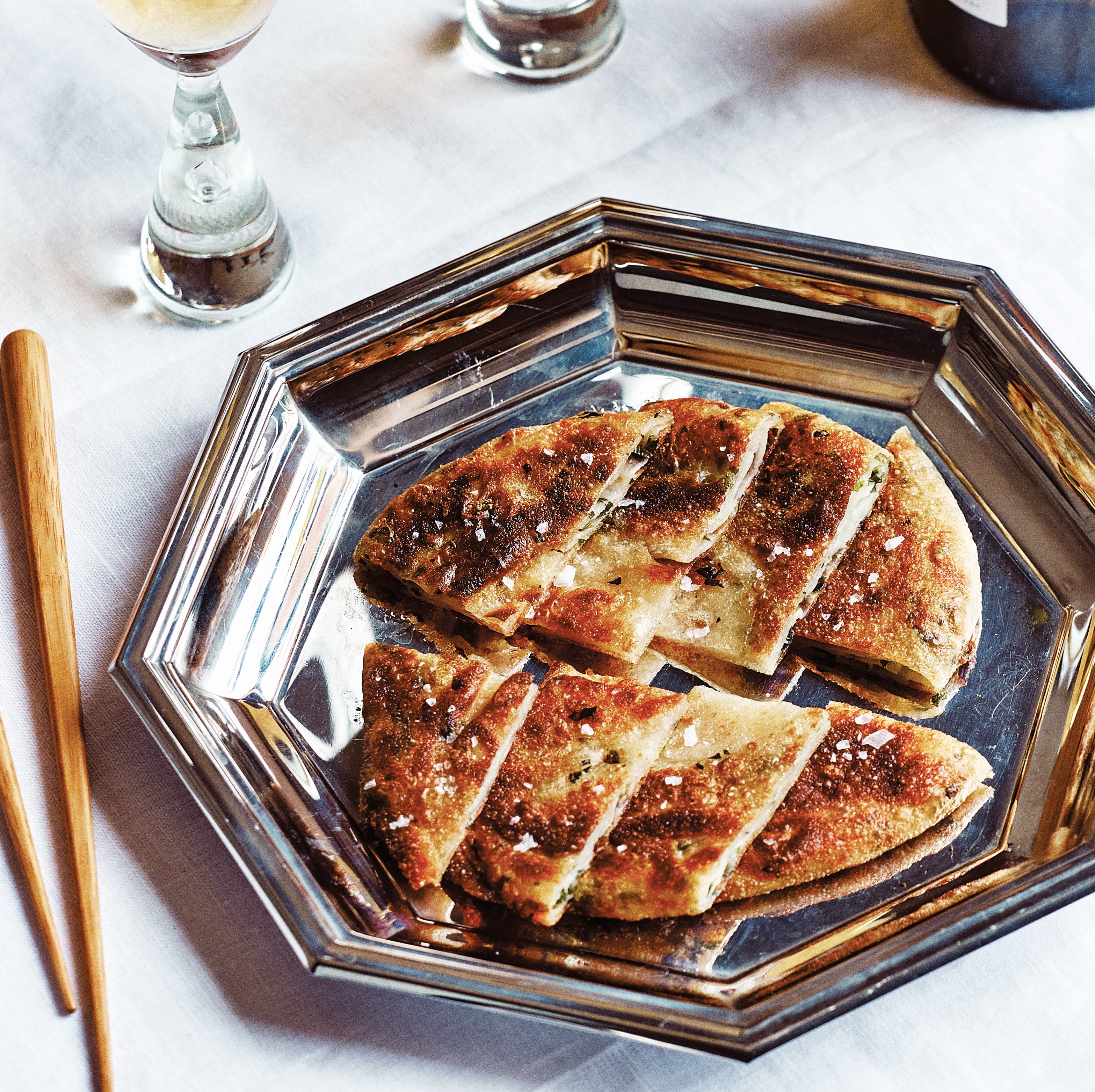
Not-Just-Scallion Pancakes
Excerpted from Everyone Hot Pot by Natasha Pickowicz (Artisan Books). Copyright © 2026.
The archetypal green onion pancake, or cong you bing—an unleavened flatbread swirled with chopped alliums—is a symphony of textural pleasure. There are the browned edges that shatter into fragments; the spiraled surface, pocked with leopard spots; the chewy, almost doughy center, rich with oil.
The shaping method is a revelation if you’re used to American-style lamination. To make cong you bing, hot water “seizes” the proteins in the flour, resulting in a smooth, resilient, relaxed dough that is a breeze to roll and twist into shapes and strong enough to hold all manner of fillings.
Each flatbread is rolled up like a scroll, coiled around like a snail, and pressed into a wide pancake; every twist and tug of the dough ensures a flaky, pull-apart texture once it’s fried in a shallow pool of oil.
Here, instead of just sticking to the classical green onion seasoning, you’ll use up all of those wilting herbs in your refrigerator, each one contributing its own unique essence.
Makes four 8-inch (20 cm) pancakes
1 cup (240 ml) filtered water
1 cup (about 30 g) packed fresh herbs (like scallions, basil, parsley, mint, tarragon, cilantro, sorrel, or dill)
2 cups (240 g) all-purpose flour
1 teaspoon kosher salt
About ¼ cup (60 ml) vegetable oil, for cooking and shaping
¼ cup (60 ml) sesame oil
Flaky sea salt, to finish
Black and Brown Vinegar, for dipping (see below)
Pour the water into a small pot and heat until boiling.
Meanwhile, finely chop the fresh herbs into confetti; measured tightly in a cup, the herbs should collapse to yield about ⅓ cup.
Combine the flour and salt in a medium bowl. Slowly stream in the hot water, stirring with chopsticks until a loose dough forms. Once the dough is cool enough to handle, bring this shaggy mixture together by hand, kneading for a minute or two.
Shape the dough into a rough ball; it will be sticky. Cover and let rest in the refrigerator to chill for at least 30 minutes and up to 8 hours.
Using a big knife or bench scraper, divide the dough into quarters, each weighing about 4½ ounces (125 g). Form a hand into a claw, like you’re holding an invisible baseball, then roll the dough pieces into smooth balls.
Lightly grease a rolling pin and your work surface with vegetable oil. Roll a piece of dough into a circle about 10 inches (25 cm) wide; the dough will be very thin and sheer. Brush the dough circle with a thin coating of sesame oil (about 1 teaspoon), and top with a heaping tablespoon of the chopped herbs.
Starting with the bottom of the circle, roll up the dough, like a scroll or a jelly roll. Twist the scroll into a tight spiral, like a snail’s shell, as it lies flat on your work surface.
Repeat with the remaining dough. Drape a dish cloth over all the dough spirals and let rest for 30 minutes.
Line a large baking sheet with parchment paper. Roll each dough spiral into a circle about 8 inches (20 cm) wide, adding a little vegetable oil to the rolling pin if the dough feels overly sticky or tears. Stack the circles on the lined baking sheet as you go, separating each one with a small square of parchment. The pancakes shouldn’t feel overly sticky or wet, but it’s okay if the herbs slightly tear the dough while you’re rolling it out. (Note: Don’t roll the pancakes too thinly, which would compress their flaky layers and result in more of a cracker.)
At this point, you can partially freeze the pancakes on a baking sheet lined with parchment paper, then stack them in an airtight container in the freezer for up to 3 weeks.
When you’re ready to cook the pancakes, heat 1 tablespoon of vegetable oil in a large skillet over medium heat. Set a baking sheet lined with a dry towel nearby as a place for the pancakes to land and drain once removed from the oil.
Fry the pancakes one at a time, 4 to 5 minutes for each pancake, flipping halfway through and replenishing the oil after each round. Transfer to the towel-lined baking sheet and sprinkle with flaky sea salt.
Using a sharp cleaver or chef’s knife, cut each pancake in half, then cut each half into 1-inch (2.5 cm) wide strips. Serve immediately with Black and Brown Vinegar on the side, for dipping.
HOT (POT) TIP: Don’t want to transfer savory smells like sesame oil or chopped alliums to your rolling pin? Roll each pancake between two squares of parchment about 12 inches (30 cm) wide.
Black and Brown Vinegar
Chinkiang vinegar, a type of Chinese black vinegar made with fermented rice, has a malty, caramelized tang that you’ll immediately want to pour all over steamed dumplings, pan-fried noodles, and flaky fish. Black vinegar is less acidic than a Western-style vinegar, but what it does have is a rich, inky undercurrent of earthiness and musk that truly transforms the simplest dish.
Similar to a classic dumpling dipping sauce, in this recipe black vinegar is balanced with a bit of seasoning, by way of soy sauce and brown sugar. The final flurry of chopped cilantro stems and julienned ginger adds a weightless, fresh brightness.
Makes 1 cup (240 ml), enough for 4 servings
½ cup (120 ml) black vinegar
2 tablespoons dark brown sugar
2 tablespoons soy sauce
¼ cup (about 15 g) thinly sliced ginger, for garnish
¼ cup (8 g) finely chopped cilantro stems, for garnish
Combine the black vinegar, brown sugar, and soy sauce in a small bowl and whisk together. When you’re ready to serve, top with the ginger and cilantro stems.
Serve immediately, or transfer to an airtight container and store in the refrigerator for up to 1 week. Add the cilantro stems and ginger right before serving.
Hot pot for the win! I should dig out the equipment this weekend :). Can’t wait for these recipes.
Hotspot is one of those things I like to do to reconnect with my friends and when I need comfort. So good!